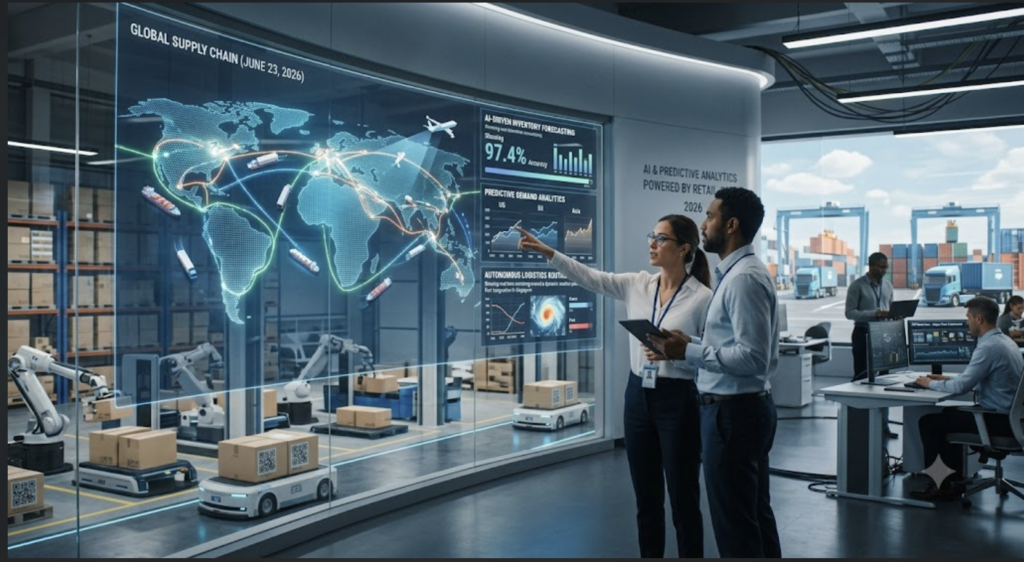

From Reactive to Predictive Logistics
For decades, retail inventory management relied heavily on historical sales data to forecast future demands. However, sudden shifts in consumer behavior and market fluctuations often led to severe overstocking or supply shortages.
In 2026, predictive AI algorithms are completely changing this dynamic. By analyzing real-time data points—ranging from localized weather patterns and social media sentiment trends to regional economic shifts—AI models can predict precisely what products will sell, where, and when. This allows retail enterprises to optimize their inventory levels before a demand spike even occurs.
Hyper-Localization and Smart Warehousing
Major e-commerce giants and brick-and-mortar retail chains are leveraging machine learning to implement hyper-localized supply chains. Instead of managing massive centralized distribution hubs, inventory is being strategically distributed to smaller, automated micro-fulfillment centers located closer to urban consumer bases.
Combined with autonomous warehouse robotics and IoT-enabled tracking, this strategy drastically reduces transit times, minimizes carbon footprints, and makes reliable same-day delivery an industry baseline rather than a premium service.
Enhancing Sustainability and Reducing Waste
Beyond boosting operational efficiency, AI integration plays a pivotal role in retail sustainability initiatives. According to recent industry reports, predictive demand forecasting has helped businesses reduce perishable inventory waste by up to 30%. By optimizing freight routes and streamlining maritime and domestic shipping schedules, automated logistics platforms are significantly curbing unnecessary carbon emissions.
The Road Ahead
As inflationary pressures and fluctuating raw material costs continue to challenge the global market, building a resilient, agile, and transparent supply chain is no longer just a competitive edge—it is a survival necessity. Retailers who continue to invest heavily in end-to-end AI integration will lead the next generation of global commerce, while those relying on legacy systems risk falling behind.
SEO Keywords (Tags):
Retail Technology, AI in Supply Chain, Predictive Analytics, E-commerce Logistics, Smart Warehousing, Retail Trends 2026.